
The linden – a healing tree as a symbol of the Slavs.
In old Slavic culture the linden was a sacred tree and people identified it with Lada, the goddess of beauty and love. In times long past our ancestors held a great many ceremonies, special rituals and other remarkable gatherings, dances among them, near an old linden or on a clearing between several lindens. The old Slavs danced beneath old lindens and with their dances honoured the linden blossom, the linden scent and the gentle, beneficial qualities of the linden and its life-giving gifts. In those distant times various important meetings, courts and assemblies were also held beneath the lindens. Besides this, it was – and in some places still is – a lovely custom to plant a linden on the occasion of a wedding, the birth of a child or another important event.
The old Slavs related to the linden as to their mother, who gave them, as her children, everything they needed. From linden wood people carved spoons and household things, but also statuettes, icons and altars. Linden wood also served for making shields and musical instruments. Magical power was ascribed to small statuettes of linden wood, which were to bring happiness, and also to linden bark, which was to protect against poisoning. Linden leaves are said to hold a magical power too, and our ancestors worked various charms with them in the hope of immortality. Belief in the mysterious and inexhaustible gifts of the linden reached so far among our ancestors that they believed – and many people believe to this day – that lightning can never strike a linden.
Since the linden grew and still grows abundantly in Eastern Europe, which is considered the ancestral homeland of the Slavs, during the national revival the writer and poet Ján Kolár called it a symbol of Slavic togetherness.
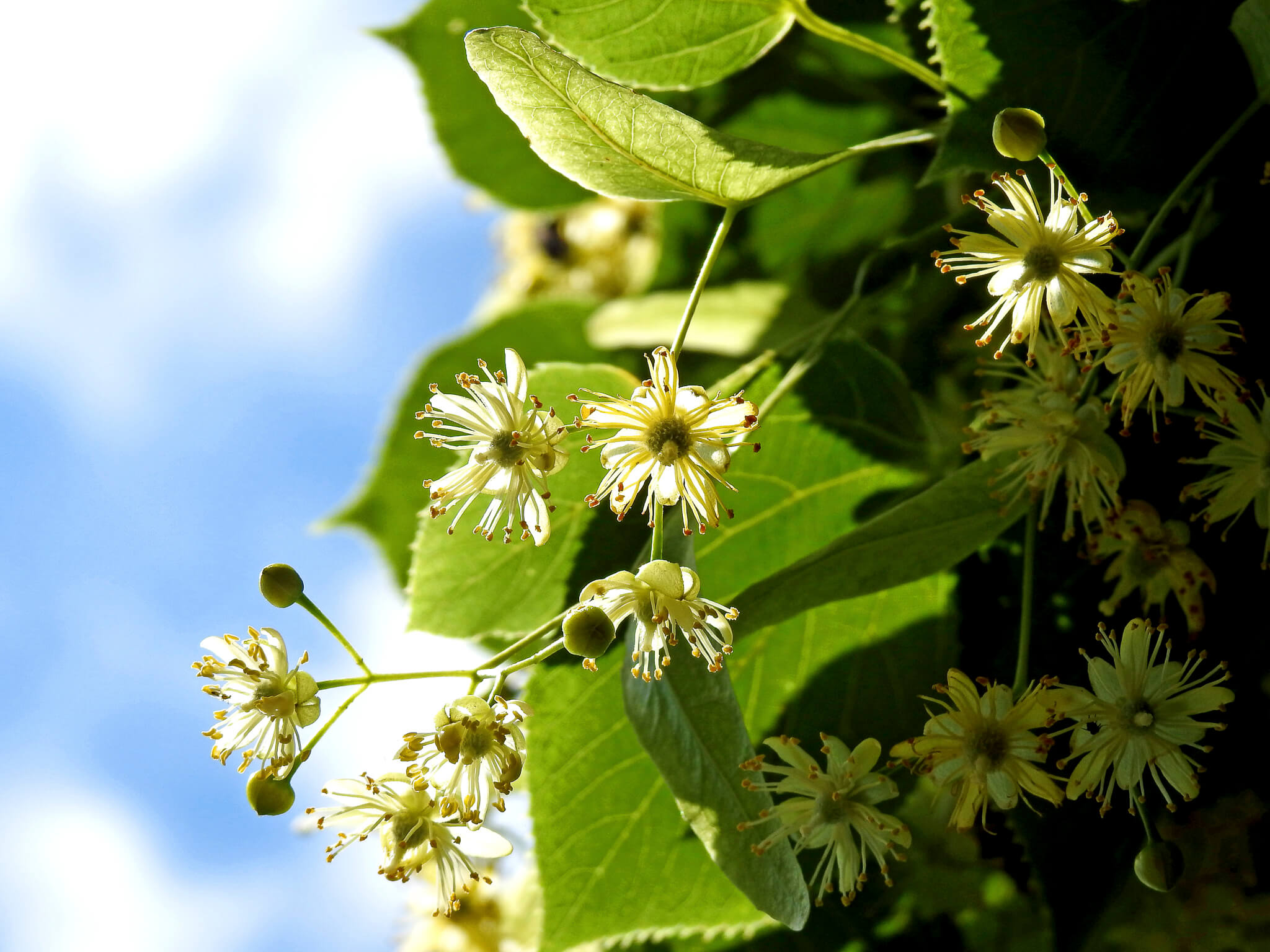
The linden is one of those trees that people recognise from afar by its lovely, piercingly sweet scent and the shape of its leaves.
The oldest linden in our country is over 700 years old.
Our own beauty is said to be over 300 years old and we love her dearly.
The linden was considered the dwelling of good spirits and is said to have the power to keep evil and dark forces away.
Qualities
The most precious part of the linden are its intoxicatingly fragrant flowers, whose qualities are traditionally cherished for the human body; they bloom from June to July. The linden flower is gathered at the beginning of the bloom.
Dried linden flowers are most often used to prepare tea. The qualities of linden flowers cannot be mistaken for those of any other tree and lie, among other things, in supporting the immune system and helping it get going.
Linden blossom contains a wealth of active substances: essential oils, substances close to vitamin E, flavonoids and organic acids.
First and foremost, linden tea is traditionally reached for with a cold and with inflammation of the airways. It is said to loosen mucus, to ease coughing and even to soften a fever. The sweat-inducing quality of linden flowers is strengthened by adding elderflower, chamomile and raspberry leaves.
The linden can be reached for not only when you already have a runny nose or the flu, but also as a gentle companion throughout the flu season. It supports the immune system and helps the body to carry unwanted substances away.
Connected with this support of carrying unwanted substances away – that is, its diuretic quality – is its traditionally valued touch on the kidneys and urinary tract.
Its calming influence on the body is traditionally reached for with feelings of fear and anxiety and with sleeplessness.
Stress
Do also make yourself a linden tea if your blood pressure has jumped up. It is a more natural path towards settling it.
A simple recipe traditionally used with suddenly raised blood pressure when stress is the cause: we pour 0.5l of boiling water over 15g of linden blossom and let it steep for 15 minutes. After straining, it is drunk by the cup throughout the day.
Sleep
The calming qualities of linden tea are well known too. With its gently sedative touch, linden tea is traditionally reached for with stress, nervousness, sleeplessness and also migraine.
A recipe for a mildly calming and strengthening effect: we take equal amounts of linden blossom, wild thyme and heather, make an infusion and serve it as an evening tea.
The calming touch of the linden herb is increased if we mix it with lemon balm leaf, valerian root, hawthorn berries or hop cones.
With sleeplessness an infusion of the following mixture is traditionally reached for: 1 teaspoon each of linden blossom, marjoram and lemon balm, over which we pour a glass of boiling water and let it steep for 5 minutes. We drink 1 cup after a meal and before sleep
The gall bladder and the digestive tract
Your gall bladder and digestive tract will notice the kind qualities of linden flowers as well, for linden tea has long been cherished for them. It is traditionally said to ease stomach troubles and to calm an irritated digestive system.
To support digestion, linden may be mixed with liquorice root, angelica root and sweet flag. To help balance the metabolism it is used, for example, in a mixture with dandelion and couch grass root, yarrow and wild pansy herb and alder buckthorn bark
Skin
Linden flowers in the form of compresses can also be used to cleanse and soothe the skin.
If you would like to try the wonderful qualities of the golden tree, as the linden was called long ago, try washing your face regularly with a linden infusion – your skin will be beautiful and clear, and besides that it will gradually take on a lovely, soft golden glow.
Bath
You can also try a bath with this gentle infusion added, which renews the body from the outside. Besides its relaxing and cleansing qualities, you can count on a soothing touch as well. Linden baths are traditionally reached for with nervous complaints, for calming and for the overall renewal of the body.A recipe for a renewing bath: we simmer 200g of linden herb and 100g of burdock root in 5l of water, pour it into the bath and bathe for about 15 minutes.
Flower water
In cosmetics, linden blossom holds a distinct and considerable place. It supports the beauty and health of the hair, which is rinsed either with a linden decoction or with linden flower water after washing the hair.
After a bath in a linden decoction or a mist of linden water, the hair is soft, shiny, springy and carries a lovely honeyed scent.
Compresses of linden blossom awaken the circulation in the skin of the face, which has a kind influence on the nourishment of the cells beneath.
Extracts of linden flowers are added to creams, lip balms or body creams. Linden blossom is traditionally said to shelter more sensitive skin. It creates a protective barrier on the skin and shows wonderful renewing qualities, keeps the water and lipid balance, soothes irritation at once and, on top of that, gives the skin a golden glow.
Self-tanning oil
Our natural self-tanning oil is also made from linden water, and besides a tan it brings a beautiful golden glow from the linden
Scrub and shea butter
The linden is part of our scrub and body butter too. The scrub cleanses the skin beautifully
Whipped linden shea butter gives it wonderful nourishment and a gorgeous scent.
Linden blossom is suitable for:
- all skin types, including delicate and sensitive, but especially for dry facial and body skin,
- it soothes the skin of the face and the scalp,
- it renews and softens the look of fine lines, and evens out the tone of the skin,
- it moisturises and holds moisture in the individual layers of the skin.
ŠTEFKA creams
Linden oil, our home-made macerate, is part of our linden face creams
Voňafka
The kind extracts of linden flowers contribute to soft, moisturised and youthful skin on the face and body and give them gentle protection and care, made all the lovelier by an exclusive warm fragrance with notes of linden blossom.
In traditional medicine linden leaves are used as well, and in spring they can enrich our menu too.
Most often linden leaves are used to make various compresses, traditionally reached for with scalds, small injuries, skin troubles and also with muscle cramps.
A salad of young leaves /they are at their best up to about May/ is very simple to prepare. Just tear the leaves finely and season them; they are wonderful with egg. We can also prepare them like spinach, or use them in various fillings for savoury pies, stuffings or dumplings.
What few people know is that chocolate can be made from the linden too. Half a kilo of unripe fruits, 40g of dried linden flowers and a little grapeseed oil. Grind the linden flowers into a powder, crush the fruits in a mortar and add grapeseed oil in such an amount that the mixture becomes a paste with the taste of chocolate. It then keeps for several days in the fridge. It is wonderful on bread as a sweet spread.
The linden of course has its beautifying qualities as well. It has strong renewing qualities, for it is very rich in vitamin E.
The linden contains a soothing mucilage, which calms the skin, strengthens the walls of the capillaries and has a comforting, settling touch.
SLOVENKA
Our new shaping body oil SLOVENKA, which contains exactly this wonderful little linden oil, plus a whole host of other treats that are fantastic for your skin, such as squalane, acmella and Q10.
A mouthwash can also be prepared from a linden decoction. For a fuller effect it is good to make the decoction from linden flowers and mint leaves. Linden and mint work beautifully together and their combination creates a really interesting taste. This home-made mouthwash is traditionally valued as antiseptic and soothing, and on top of that it freshens the breath wonderfully.
Linden blossom is a strong sedative and can become habit-forming, so taking it regularly is not recommended. In higher doses it can have narcotic effects.
Because linden blossom is considerably allergenic, we never inhale it