
Do you have a cough? Are your joints aching? Gather some coltsfoot and make yourself a tea, a syrup, a honey or a compress.
COLTSFOOT
Coltsfoot was known as a herbal plant already in ancient times. Pliny, for example, recommended setting light to dry coltsfoot leaves and breathing in their smoke through a little tube. A sour soup was also cooked from coltsfoot leaves, and its roots were eaten too, tasting like cabbage stalks.
Coltsfoot is also among the first plants that nature offers us after a long winter. Like nettle, lungwort or cowslip, coltsfoot belongs among the plants traditionally used for cleansing the blood. Coltsfoot is traditionally reached for with a cough.
Coltsfoot belongs among the so-called mucilaginous herbs, which are said to shelter irritated places by laying a fine layer of mucilage over them, easing irritation and discomfort and so supporting the natural calming of inflammation.
The herb has also proved itself in traditional care during asthma. It is said to calm a cough, yet where it is needed it supports expectoration.
It is traditionally used with diabetes as well, thanks to zinc, which is said to improve the use of insulin.
The leaf herb is also recommended in folk tradition for preparing an enema in cases of inflammation and ulcers of the large intestine and with Crohn's disease.
Coltsfoot is very welcome here in combination with silverweed, or possibly with paruman spanilý. The flowers are traditionally used above all where there are cramps.
Early in spring (March - April), in dry weather, the yellow flowers are gathered while they are not yet fully open or have just opened. The leaves are gathered at the beginning of summer; they grow only after the plant has finished flowering. Young, healthy and undamaged leaves are cut off. Both flower and leaf are dried in thin layers, so that they do not overheat and the dried herb is not spoiled. The flowers must keep their original yellow colour.
Coltsfoot flowers contain: mucilage, glycoside bitters, tannins, flavonoids, yellow pigments (xanthophyll), essential oil.
The leaf contains: mucilage, catechin tannins, organic acids ( malic, tartaric, citric, gallic), inulin, triterpenes, sterols, potassium, zinc
It is not only the flowers of coltsfoot that are useful; the leaves are good for us too. Crush them and prepare a compress for inflamed veins. It is traditionally said to bring relief with leg ulcers and other skin troubles, and to soothe aching joints with rheumatism. Apply the compress morning and evening and let it work for an hour.
When you do not have fresh leaves, prepare a stronger decoction from dried, crumbled ones. Simmer three tablespoons in half a litre of boiling water for five minutes, stir now and then, take off the heat and let it steep for half an hour.
Strain it and soak a gauze or a piece of linen cloth in the warm tea. Wring it out lightly, place it on the affected area and wrap it with a plastic bag. Let the compress work for an hour and repeat it three times a day.
A so-called dry wrap in coltsfoot leaves is traditionally used with rheumatism and aching joints; it should be applied for about one hour.
In traditional care during shingles it is recommended to dip a handful of fresh leaves briefly into boiling water and, once drained, to lay them on the affected place
Leaves crushed into a pulp are used for chest compresses, traditionally reached for as support during troubles of the lungs and bronchi.
Coltsfoot is also used as a diuretic and anti-inflammatory herb, and it is said to be of help with diarrhoea.
Coltsfoot syrup
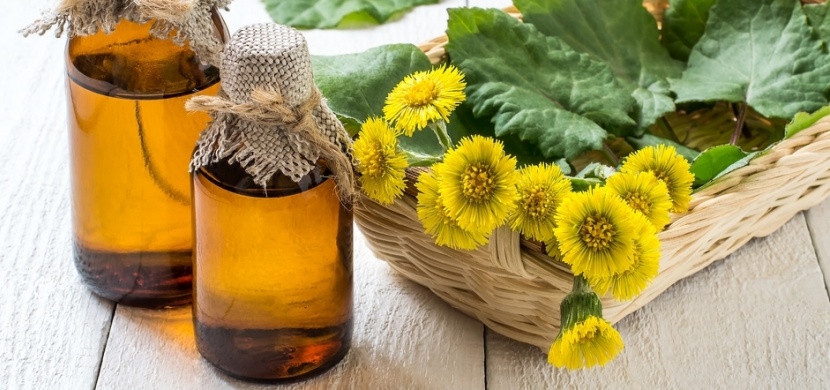
A traditional syrup can be prepared from coltsfoot leaves, suitable for small children too. Into a glass bottle we pour alternating layers of sugar and chopped coltsfoot leaves. We let this mixture stand for about four weeks, until the sugar dissolves. The traditional way is to bury it in the ground. We bury the filled jar in the garden and place a small wooden board over it.
The even temperature of the earth allows the coltsfoot to ferment.
We leave it in the ground for 8 weeks.
Then we strain the syrup and store it in glass bottles in the fridge.
For coltsfoot honey you will need
freshly gathered coltsfoot flowers or leaves and
natural sugar
Into a jar with a lid, place one after another a layer of washed and dried flowers (about 1 cm) and a layer of sugar (about 3 cm), all the way to the top; finish with a layer of sugar. Press each layer down. Close it and keep it in a cool place for roughly 6 weeks. When the coltsfoot releases its juice, pour the contents of the jar into a little water, stir, simmer briefly and strain. Warm it again until the juice thickens. Store the syrup in the fridge and take it by the teaspoon when you have a cough, max. 3 teaspoons a day.
With chronic bronchitis and asthma, dried and chopped coltsfoot leaves were traditionally used as tobacco for smoking. They are said to dissolve mucus, to support a cleansing cough and to make breathing feel freer.
With a headache we lay fresh coltsfoot leaves on the forehead of the person who is unwell, with the hairy side facing down. A fresh coltsfoot extract dropped into the ear is traditionally used with earache.
Coltsfoot tincture is said to dissolve mucus very effectively.
A dry cough, which is so tiring, is something we wish to calm. That is why we reach for remedies that soothe a cough - antitussives (coltsfoot belongs here too).
Homemade coltsfoot syrup or tincture is much loved for soothing a cough. We use it with inflammation of the upper airways, to help expectoration and to calm inflammation.
A leaf compress for aching joints
Remove the stalks from fresh coltsfoot leaves and rinse them thoroughly in cold water. Lay them over the aching joint in two layers. Always place them with the upper, green side down. Secure the leaves with a bandage and wrap them in a scarf for several hours
With a cough, hoarseness and congestion, a decoction of 10g of leaves and flowers is recommended: put them into a quarter of a litre of cold water, bring to the boil and then let it steep for 10 minutes. It is drunk sweetened with honey. A powder from dried leaves has a similar effect; a knife-tip of it is taken 1 to 2 times a day.
Coltsfoot is lovely to combine with soapwort root, anise, cowslip, marshmallow, sage leaf or chamomile flowers.
A tea blend for congested bronchi and lungs:
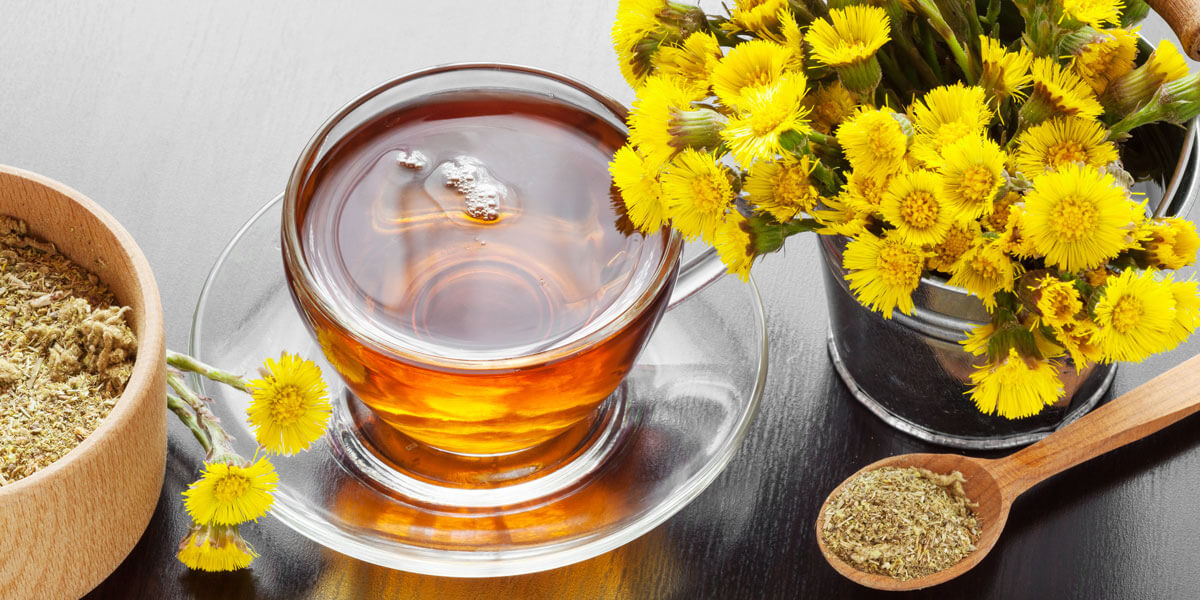
5 parts each of coltsfoot leaves, coltsfoot flowers, lungwort flowers and mallow flowers, 4 parts each of mullein flowers and plantain leaves, and 3 parts of marshmallow root. Pour 0.5l of boiling water over two spoons of this blend and let it steep for 15 minutes. Finally sweeten with honey. We drink the tea lukewarm, several times a day, in little sips
Fresh crushed or ground coltsfoot leaves make a lovely mask for congested and oily skin . It soothes the skin, firms it and brings a rosy glow. A decoction is used to bathe irritated skin with blemishes.
Please be careful when using coltsfoot!
Preparations from coltsfoot leaves and flowers should not be taken over a long period, as some of the substances they contain may have a harmful effect on the liver. In tea blends, where coltsfoot makes up roughly a 15% share, it is not dangerous.
The maximum time of using coltsfoot in one year should not exceed 4 weeks!!!
During pregnancy and breastfeeding, because of its content of pyrrolizidine alkaloids, coltsfoot is not recommended for internal use at all.