
Hot days, the holidays and warm rays have a special, unmistakable magic for children. Summer comes with bare feet in the grass, laughter by the water, sand between the toes, trips, holidays and endless days outdoors. Yet it is in these beautiful moments that children's skin needs far more attention than the skin of an adult. As we know well, the skin of little explorers is finer, more sensitive and more vulnerable. That is exactly why the sun can irritate or burn a child's skin faster than a parent notices the first redness. So how do you choose the right product that not only protects, but is also gentle enough for a child's skin? Should it be SPF 30 or SPF 50? Mineral or chemical? Fragranced or fragrance-free? And how often should it actually be applied? Let us explain it simply, kindly and practically.

Why children's skin is more sensitive to the sun
Children's skin is still developing; it is thinner, finer and its natural protective mechanisms are not as strong as in adults. That means it reacts to sunlight faster and can be irritated or burnt more easily. Expert recommendations agree that, wherever possible, babies under 6 months should be kept out of direct sun altogether. Let us not forget that even though shade is the best protection for babies, it is also important to think of light clothing and a little hat. With older children a combination of several steps matters: shade, a head covering, suitable clothing, plenty of fluids and a quality sun preparation.
What SPF means and which factor to choose for children
SPF indicates the level of protection from UVB rays, the type of radiation mainly responsible for sunburn. Dermatologists recommend choosing a sun preparation with SPF 30 or higher, which is broad spectrum (protecting against both UVA and UVB rays) and water resistant. SPF 30 is suitable protection for ordinary summer days, trips, walks and time outdoors, if it is applied correctly and regularly. SPF 50 or 50+ may be a good choice for very sensitive skin, at the seaside, in the mountains, during a longer stay outdoors or if a child tends to redden quickly. It is important to know one thing, though: a higher factor does not mean a child can stay in the sun all day without reapplying. Even a sun cream with a high SPF needs to be reapplied roughly every 2 hours and always after swimming, perspiring or drying with a towel.
UVA and UVB protection
When choosing a children's sun cream, it is not enough to look only at the SPF number. It is just as important that the product is marked as broad spectrum, that is, protecting against both UVA and UVB rays. UVB rays cause sunburn in particular, while UVA rays penetrate deeper into the skin and are associated with premature ageing of the skin and damage to skin cells.
Mineral versus chemical filters
Sun preparations may contain chemical, mineral or combined UV filters. Chemical filters absorb UV radiation and turn it into heat. They can be pleasant to apply, but with very sensitive skin they may not suit some children. Mineral filters, such as zinc oxide or titanium dioxide, create a protective layer on the skin and are often the preferred choice for sensitive children's skin, because they tend to be gentler and less irritating.

What to avoid in a children's sun cream
When choosing an SPF for children, a simple rule applies: the more sensitive the skin, the gentler the composition. Avoid products with strong fragrance, needlessly irritating ingredients, or products that are not intended for children's skin. With sensitive children, atopic skin or children prone to irritation, it is always good to try the product on a small area of skin first.
How to apply sun cream to children correctly
Even the best sun cream will not protect properly if too little is applied or if it is not reapplied. Apply it in a generous layer to all the places that will be exposed to the sun. Do not forget the ears, the neck, the shoulders, the tops of the feet, the backs of the knees, the hands and the nose. Apply the sun preparation before going outdoors and reapply it regularly during the day. For a longer stay outdoors, a few golden rules apply: reapply roughly every 2 hours, and always after swimming, perspiring or drying with a towel. Do not forget to apply it even when the sun hides behind a cloud, since water, sand and concrete can also reflect the sun's rays. The AAP reminds us that it is possible to get sunburnt even on a cloudy day, because part of the UV radiation passes through the clouds.
Sun cream alone is not enough
SPF matters, but it should not be the only protection. It works best in combination with other measures.
During summer days, treat your children to:
- Time in the shade, a hat or a cap that protects the ears and neck
- Light, breathable clothing, ideally with UV protection
- Sunglasses with a UV filter
- Plenty of water
- Breaks from direct sun
- Avoiding the sharpest sun between roughly 10:00 and 15:00.
Do not forget the evening wash and hydration
After a whole day outdoors, the remains of the sun preparation, perspiration, dust, sand, salt or chlorine stay on the skin. That is why it is important to wash the skin gently but thoroughly in the evening. Do not use aggressive shower gels that can dry the skin out and give preference to oil-based products. As a lovely choice we recommend the BUBÁČIK children's washing oil. After washing, treat your child's skin to hydration – a body lotion, cream or balm that supports the skin barrier and helps the skin recover after a sunny day. Here too we recommend finishing the whole routine with the children's body lotion with oats from the BUBÁČIK range.
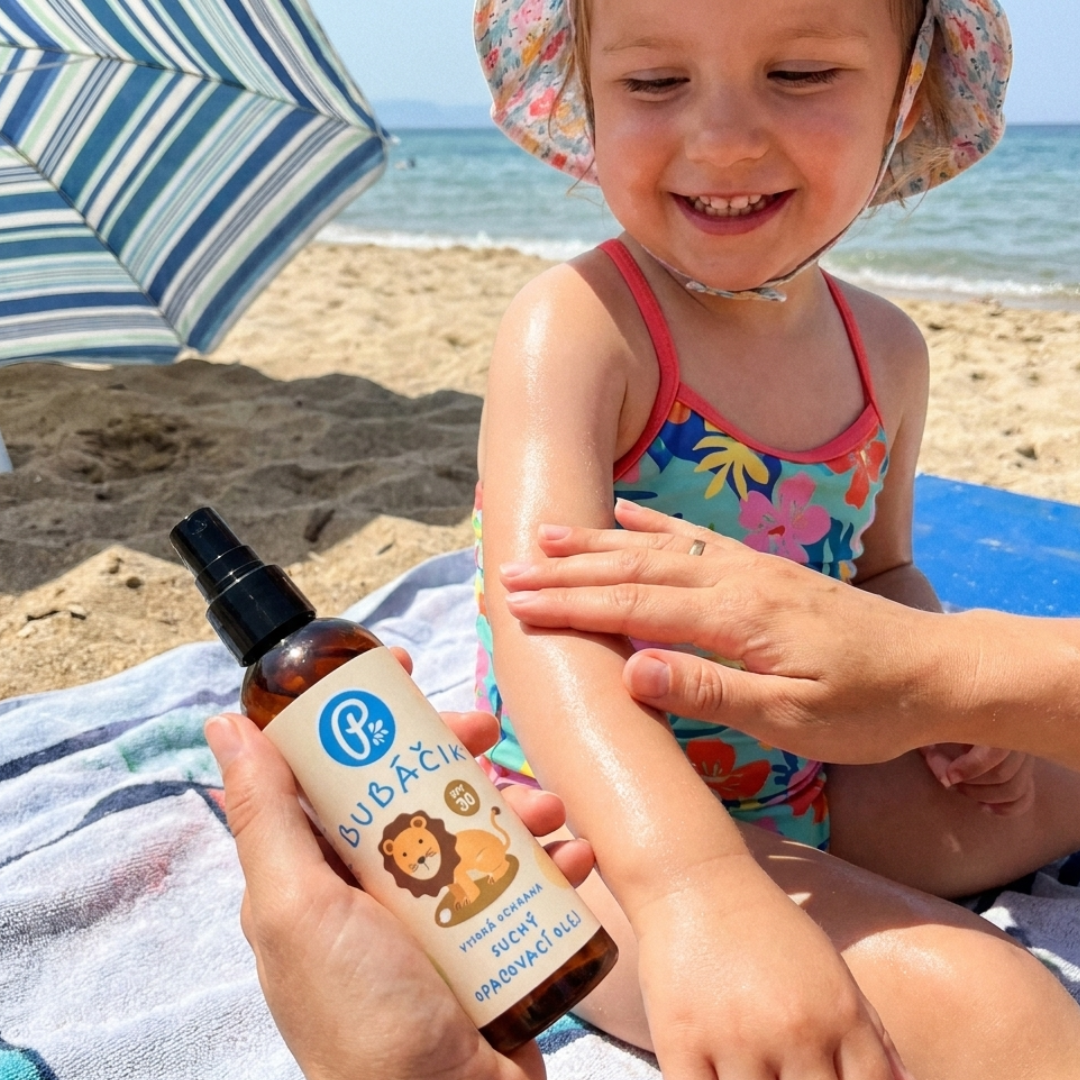
Our tip: BUBÁČIK® children's dry sun oil SPF 30
If you are looking for natural mineral protection for children from 3 years of age, reach for the BUBÁČIK® children's dry sun oil with SPF 30. It is created for fine and sensitive children's skin. Its base is non-nano zinc oxide, a mineral UV filter, which helps to physically reflect the sun's rays. It protects against both UVA and UVB rays, has a 100 % natural mineral composition, is fragrance-free, dermatologically tested and also contains an active substance from sea algae. Unlike many rich mineral creams, it spreads well, leaves no white film and has a lighter, dry oil finish. It is lovely for summer trips, days by the water, time in the garden and everyday protection on sunny days.
How to use: apply in a generous layer to the skin of the face and body before going out in the sun. Repeat the application every 2 to 3 hours, and more often when swimming or perspiring. In the evening, wash the skin gently and treat it to hydration.
A little parent checklist when buying a sun product
When buying, ask yourself these questions:
- Does the product protect against both UVA and UVB rays?
- Does it have at least SPF 30?
- Is it suitable for children and for their particular age?
- Is it suitable for sensitive skin?
- Does it contain mineral filters, zinc oxide for example?
- Is it fragrance-free?
- Does it spread well?
- Is it dermatologically tested?
- Can you easily reapply it during the day?
If you answer yes to most of the questions, you are on the right path.
Children's skin deserves gentle yet consistent protection
Even though the sun's rays bring our little ones joy, energy and beautiful memories, they also bring many pitfalls for their health. That is why it is essential to choose a well-selected sun preparation that helps to protect delicate children's skin from burning. When choosing, do not go by the packaging or the scent alone. Look at the composition, the type of filters, the UVA/UVB protection, the age recommendation and how the product behaves on the skin.