
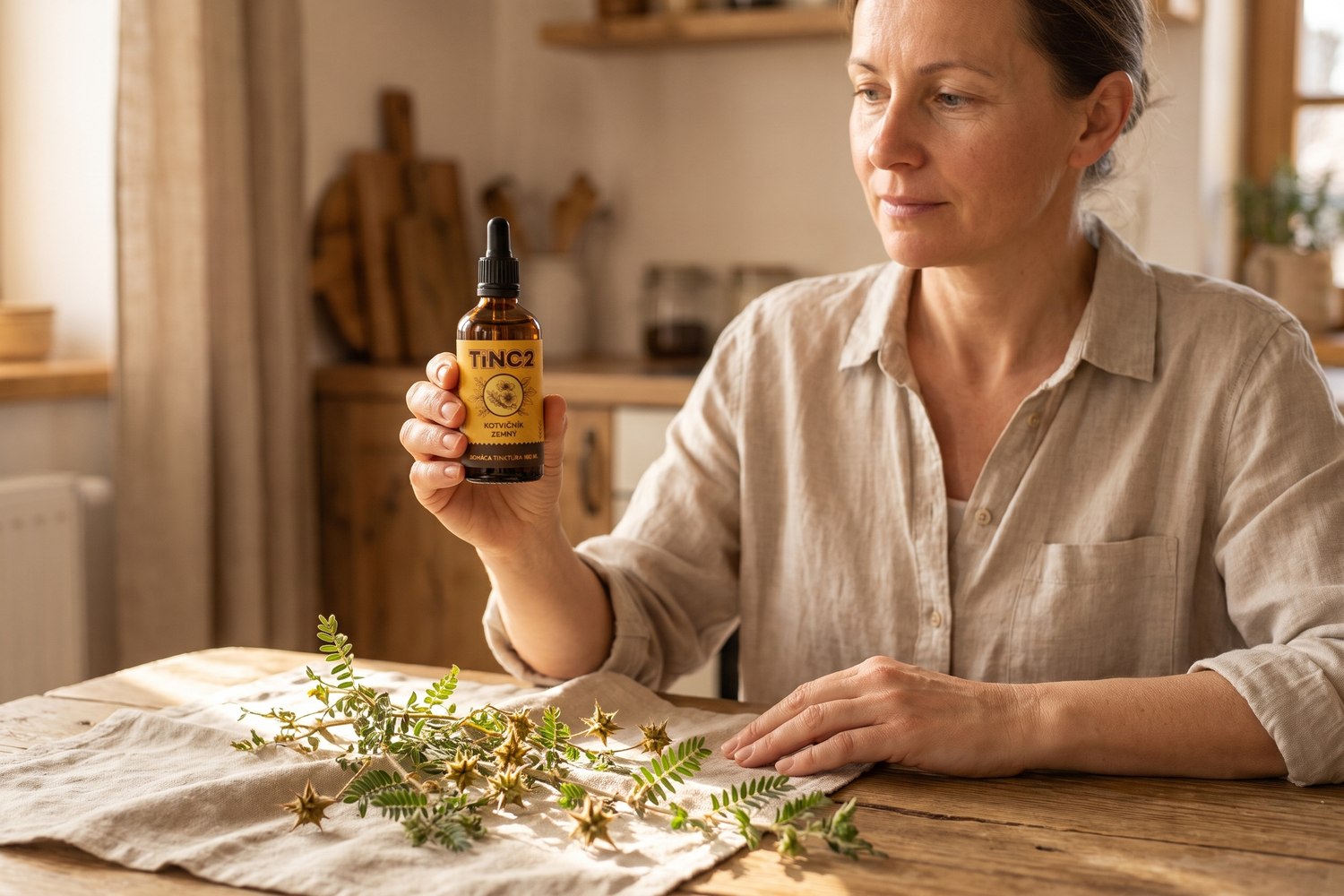
Puncture vine (Tribulus terrestris) is a small, hardy plant with yellow flowers and tiny spiny fruits, known to herbal traditions in Asia and in Europe. You will find a tincture of its herb in the tinctures category as the Puncture Vine Tincture 100 ml. You can read more about the plant in the herbarium on this website.
What puncture vine is and what it looks like
Puncture vine is Tribulus terrestris in botanical terms, and in folk speech it is also called goathead. It is an annual creeping plant that grows low to the ground, and according to the Panakeia herbarium it thrives in various regions of Europe, Asia, Africa and the Middle East. It has small leaves and bright yellow flowers, which leave behind tiny spiny fruits. In herbalism, different parts of the plant are processed: tradition mentions the roots and fruits, while the Panakeia tincture is, according to the product page, made from the herb, that is the above-ground part. So when choosing, it is worth checking which part of the plant a product is made from, because it is not the same thing even when the name is the same. The Latin name on the label will help you tell the plant from others with a similar name.
How puncture vine was used in tradition
The Panakeia herbarium mentions that the roots and fruits of puncture vine are part of traditional Chinese medicine and Indian Ayurveda. That is history, not a recommendation. Long lists of promises appear online around herbs, but you will not find them here. A health claim may be made for a food supplement only if the European Union has approved it, and this is governed by Regulation No 1924/2006. So we would rather say what we can verify than what is written. You can read what researchers write about the plant in the PubMed database under the heading studies on puncture vine. The studies vary in quality and do not replace a conversation with a doctor or pharmacist, so take them as reading, not as instructions.
What is in puncture vine tincture and how to read the label
The product page gives a short list of ingredients: distilled water, ethanol with an alcohol content of 35% by volume and an extract of the herb of puncture vine. Ethanol is there as a solvent, because a tincture is by definition an extract of a plant in a mixture of water and alcohol, so it is an alcohol-based product, which is worth knowing especially if it is to be used by someone who cannot or does not want to have alcohol. According to the page, it is a food supplement intended for internal use. You will find the dosage and method of use on the label, and we do not deal with them in this text so as not to alter what is written on the packaging itself. The table shows what to take from the label and why it is worth knowing, if you also want to compare other tinctures.
| Label information | What is stated | Why to notice it |
|---|---|---|
| Latin name | Tribulus terrestris | Tells the plant apart from others with a similar name |
| Part of the plant | Herb | Products made from the root or fruit may differ |
| Solvent | Water and ethanol, alc. 35% vol. | It is an alcohol-based product |
| Volume | 100 ml | Helps you compare the prices of packs |
| Storage | Dry and dark place up to 25 °C, away from the sun | The label asks for protection from direct sunlight |
| Distributor | PANAKEIA SK s.r.o., EU | You know who to turn to |

How to store the tincture and what to watch for
The label advises keeping the tincture in a dry and dark place at a temperature up to 25 °C, out of reach of small children, and protecting it from direct sunlight. It is shaken before use. It also says that the recommended daily dose must not be exceeded and that the food supplement does not replace a varied diet. It is not intended for children. If you take medicines, have health problems or are worried about something, ask a doctor or pharmacist before you start taking anything. This is not a formality: herbal preparations are not always neutral, and a doctor can judge what goes with what. You will find the shelf life on the packaging, not in the article, as the maker sets it for a particular batch. If anything seems different from usual, do not use the product and ask. Before buying any herbal tincture, go through this short list:
- The Latin name of the plant and the part the extract comes from.
- The alcohol content of the tincture.
- The warnings on the packaging, especially regarding medicines and health problems.
- A maker or distributor with an address you can turn to.
Why experiences with puncture vine vary so much
If you type "tribulus terrestris experiences" into a search engine, you will find many personal stories, from enthusiastic to neutral. They are the subjective impressions of individuals, and what has worked for one person need not hold true for you. There are several reasons. People take different products made from different parts of the plant, in different forms, and nobody follows exactly the same conditions. You will find customer reviews of the product on the page of the Puncture Vine Tincture, where you can read them in peace and without hurry. If other plants interest you too, take a look at the herbarium, where plants are described one by one and read at leisure. On health questions, go by the advice of an expert, not someone else's experience, even when the story is a nice one.
Did you know…
Did you know that puncture vine is Tribulus terrestris in botanical terms and that, according to the Panakeia herbarium, it is also called goathead in folk speech?