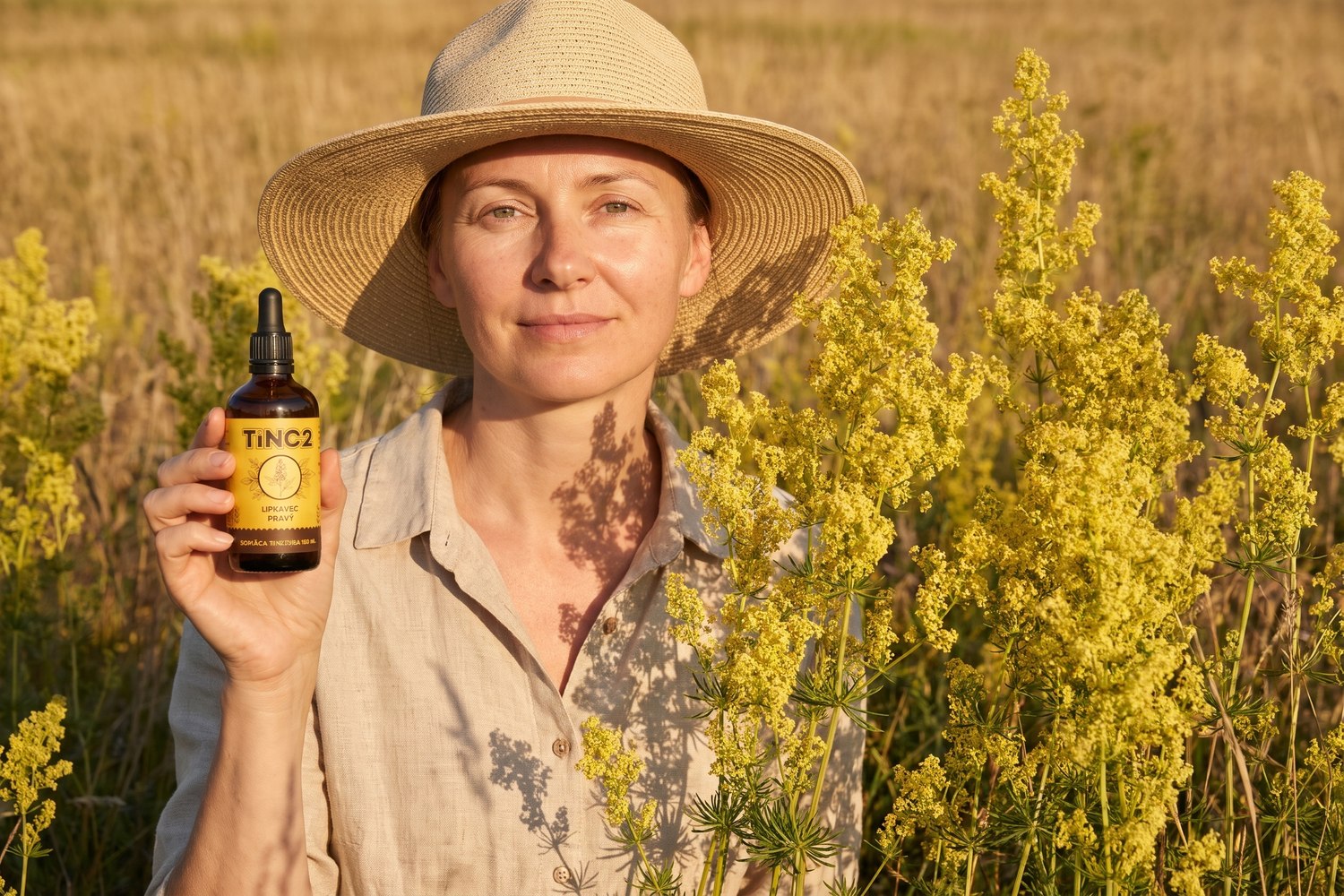
Bedstraw (Galium) is a genus of unassuming plants from the madder family, whose thin stems cling to clothes and socks. Among them stands out lady's bedstraw (Galium verum) with its yellow flowers, from which the Lady's Bedstraw Tincture 100 ml is made. Its extract is also in the day cream VRÁSKOŽRÚT. You will find more about herbs in the herbarium, and the Advisor will help you choose.
What bedstraw is and why it sticks
There are many species of bedstraw, and most of them look much alike to a gardener's eye: slender stems, tiny narrow leaves arranged in whorls and plenty of small flowers. The first thing that catches your attention is the stickiness. Some species have hooked bristles on the stem and leaves, which cling to clothing, animal fur and palms, and that is where the name comes from. Bedstraw grows in meadows, on field margins, at the edges of woods and on dry slopes, and many people see it more as a weed than as a herb. For a botanist, though, it is more interesting that two bedstraws that cannot be told apart at first glance may be entirely different species, and that not all of them are equally sticky.
Which species of bedstraw do we know
The most common question is what the difference is between lady's bedstraw and cleavers, or hedge bedstraw. Words wear thin in everyday speech, so one plant is called by three names and the other way round. The table helps: it lists the most common species and the features by which they can be told apart. The details are basic botanical ones, and when gathering in the wild always compare them with a plant atlas, because mistaking one for another is easy. The name alone will not tell you everything, since some folk names overlap between different species. Sweet woodruff from the last row of the table, on the other hand, grows in woods, which you cannot say of lady's bedstraw.
| Common name | Latin name | How to recognise it |
|---|---|---|
| Lady's bedstraw (cheese rennet) | Galium verum | Yellow flowers in densely branched panicles, narrow leaves in whorls, grows in dry meadows and on field margins |
| Hedge bedstraw | Galium mollugo | White flowers, a soft stem that is upright or sprawling |
| Cleavers | Galium aparine | An annual, stem and leaves with hooked bristles that cling to clothes |
| Sweet woodruff | Galium odoratum | A woodland species with white flowers, leaves in whorls, not lady's bedstraw |
The distinction that gets lost in everyday speech matters: it is not all the same which bedstraw you are holding. The Lady's Bedstraw Tincture is made from the species Galium verum, and we say nothing about other species, because we cannot support that they behave the same way. So the word lady's is not decoration but a precise identification. The species is also known as cheese rennet, a name that refers to the traditional use of lady's bedstraw for curdling milk in home cheesemaking. The reverse is true of cleavers, which sticks to clothes so strongly that even children know it, but that does not mean it suits a tincture or that it can be swapped for lady's bedstraw.
How to recognise lady's bedstraw in a meadow
If you are curious what lady's bedstraw looks like in the field, a few features help, and you should look for them together, not one by one. The plant is not very striking, so mistaking it for related species is no exception. When you find it in a garden or meadow, do not gather it on the strength of a single feature and never use it on a guess. A plant atlas and a local expert are better advisers than the impression from a photograph. The basic features of lady's bedstraw are these:
- tiny yellow flowers in dense panicles, which bloom in summer,
- narrow leaves arranged in whorls along the stem,
- it grows in dry, sunny places, on field margins and in meadows,
- unlike cleavers, it sticks to clothes less.

What lady's bedstraw tincture is made of
The ingredients of the tincture are short and readable at a glance: distilled water, ethanol and an extract of lady's bedstraw (Galium verum). It is a food supplement, not a medicine, and the maker states on the label that it is not a substitute for a varied diet and is not intended for children. If you are curious what a herbal tincture actually is, read the article tincture, what it is and when to use it. We do not state the dosage in the article, we stick to the label, because it can change from batch to batch. The table sums up the information given on the packaging, so that you have it to hand before you buy and when you read the label at home. You will find more herbal drops in the tinctures category, where you can also compare other plants and their ingredients on the labels.
| Label information | Value |
|---|---|
| Volume | 100 ml |
| Ingredients | Distilled water, ethanol, extract of lady's bedstraw (Galium verum) |
| Alcohol content | 35% vol. |
| Storage | In a dry and dark place, up to 25 °C, out of reach of small children, protect from sunlight |
| Before use | Shake |
| Distributor | PANAKEIA SK s.r.o., EU |
Bedstraw in cosmetics
Bedstraw is also used in cosmetics, and you will find it in the VRÁSKOŽRÚT edition. In the day cream it is listed in the ingredients as Galium Verum Extract, in fifth place after rose water, sunflower oil and two emulsifiers, Cetearyl Olivate and Sorbitan Olivate. It is followed by squalane, hyaluronic acid and coenzyme Q10 (Ubiquinone). The order does not tell you the percentage, but it shows where the ingredient stands in the list and what surrounds it in the formula. Cosmetics do not work with health claims here, only with the feel and look of the skin. If this side of the plant interests you more, take a look at the article on lady's bedstraw in cosmetics, which deals with exactly this, while this text is about the plant.
What we know about tradition and research
Bedstraws have always grown in meadows and on field margins, and folk herbalism paid them attention. Written records are few, however, and what was passed down about their use differs from region to region and from family to family, so one cannot speak of a single tradition. We therefore take tradition as background, not as a promise, and we do not attribute any particular use to it. What science says about the genus Galium you can look at through the studies on Galium verum in the PubMed database. Read them with the understanding that a laboratory finding is not a claim about a finished product. Under the European regulation on nutrition and health claims, for supplements we may only state approved claims.
Did you know…
Did you know that lady's bedstraw is also called cheese rennet, because it is the same species, Galium verum?